Materials guide
Latex Layers, Feel, and Support: Understanding Natural Latex Construction
A latex mattress is not defined by one material alone. The thickness, firmness, and arrangement of its layers shape how it cushions pressure, supports the body, and responds when you move. Learning to read those construction details can turn vague comfort language into useful questions.
Published November 5, 2026
Descriptions of natural latex mattresses often lean on words such as buoyant, responsive, supportive, and breathable. Those terms can help sketch a feeling, but they do not tell the whole story. Two mattresses made with latex can feel markedly different because their layers differ in thickness, firmness, density, processing method, and relationship to the other materials around them.
Construction is the practical bridge between a material’s properties and the way a sleep surface behaves. A softer upper layer may ease pressure at the shoulders and hips; a firmer, thicker core may resist deeper compression. A cover quilted with wool can change the first impression, while the frame beneath the mattress can influence how consistently it performs. Rather than treating “natural latex” as a complete specification, examine the whole stack.
This guide explains the main details to look for, how layers work together, and which questions can clarify a mattress description. It is an evaluation framework, not a promise that one construction will suit every sleeper. Comfort depends on body shape, sleeping position, preference, and the support surface underneath.
Start with the layer map
A latex mattress may use one continuous latex core or several distinct layers. In a layered design, the upper section is often intended to provide initial cushioning, while deeper material supplies resistance and helps limit how far the body settles. The terms “comfort layer” and “support layer” describe their roles, but exact labels vary by manufacturer.
Ask for a layer-by-layer breakdown rather than relying on a total thickness figure. A mattress described as eight inches thick, for example, might use a three-inch medium layer over a five-inch firm core. That arrangement is different from a single eight-inch block, even if both are made from the same broad material category. A clear specification should name each layer’s thickness and firmness, identify its material, and explain whether it can shift or be rearranged.
- Upper comfort layer: The first substantial layer beneath the cover. Its firmness and thickness affect the initial feel and how much cushioning is available near the surface.
- Transition layer: When present, this layer can create a gradual change between a softer top and a firmer base. Not every design includes one.
- Support core: The deeper, load-bearing section. Its thickness and firmness contribute to the mattress’s overall resistance and stability.
- Cover and quilting: Cotton, wool, or other materials around the latex affect surface feel, moisture handling, and care. They are part of the construction, not merely decoration.
Layer count alone is not a quality score. A thoughtfully specified single core may be suitable for a particular design, while multiple layers can offer more control over feel. The useful question is what each layer does and whether the description makes that role understandable.
Thickness changes how layers behave
Thickness matters because it determines how much material lies between the body and the deeper support structure. A thicker soft layer may allow more initial sink, though the effect depends on its firmness and the person resting on it. A thin soft layer over a firm core may feel more direct; a deeper comfort layer may provide a more pronounced cushion before the core’s resistance becomes apparent.
These are tendencies, not universal outcomes. A person’s weight is distributed differently across the mattress depending on body proportions and sleep posture. Someone sleeping on their side may notice pressure at the shoulder and hip more quickly than someone lying on their back. The same mattress can therefore feel differently to two people—or to one person in different positions.
When reading specifications, check whether thickness refers to the latex itself, the full mattress, or the overall finished height including cover and quilting. Ask whether layers are separately manufactured and how they are held in place. Individually wrapped layers, a fitted fabric casing, or other construction methods may help limit shifting, but the details should be stated rather than assumed.
It also helps to distinguish a mattress’s total height from its usable latex depth. A thick quilted cover may add height without adding the same kind of support as a latex layer. Conversely, a relatively simple cover can leave the underlying material’s response more noticeable. The best comparison is not a number by itself but a complete description of what that number includes.
Firmness ratings: useful, but incomplete
Firmness labels are shorthand. “Soft,” “medium,” and “firm” help organize options, but there is no guarantee that one maker’s medium will feel like another maker’s. Ratings may describe a latex layer in isolation, the assembled mattress, or a general intended feel. Before comparing figures, find out what is being rated.
Some manufacturers publish an ILD or IFD figure—an indication of the force needed to compress a material by a specified amount under a test method. Such figures can make specifications more concrete, but they should not be treated as a direct, universal comfort scale. Results and interpretation depend on the method, the material, and the complete mattress. A number for one layer cannot, by itself, predict how a person will experience the assembled surface.
Firmness is also not the same as support. A surface can feel firm at first touch yet allow a body to settle unevenly, or feel gently cushioned while maintaining stable resistance beneath. In practical terms, consider whether the design allows the shoulders and hips to settle enough for comfort while keeping the body from feeling unsupported. That balance is personal and is best judged through a realistic trial where possible.
Instead of asking only, “How firm is it?” ask more specific questions: How firm is each latex layer? What is the firmness of the core? Is the rating measured or simply described in words? Does the cover add quilting that changes the surface feel? Can the manufacturer explain what the rating applies to?
Resilience, pressure relief, and movement
Latex is often described as resilient: after pressure is applied and released, the material tends to recover its shape. In use, this may create a springier, more immediate response than materials that contour more slowly. The difference matters to people who prefer a surface that makes changing position feel easy, but the experience varies with construction and firmness.
Pressure relief is not a magic property attached to a material label. It depends on how much the upper layers give, how broadly they distribute load, and how the mattress supports the sleeper below. A very firm top may not provide enough contour for some side sleepers; a softer, thicker top may feel too yielding to someone who prefers a flatter surface. Neither description is automatically better. The aim is a workable balance for the individual.
Motion is another area where broad claims can mislead. Responsive latex may return energy quickly, while the way movement travels across a mattress also depends on the layer arrangement, the mattress size, and the base. If two people share a bed, consider the effect of movement in an actual trial rather than assuming that “latex” guarantees either isolation or transfer.
A careful evaluation might include lying in the positions used most often, allowing time for the surface to settle, and noticing whether pressure, ease of movement, and overall stability feel acceptable. A brief showroom test cannot reproduce a full night, but it can provide better information than a slogan. At home, use any trial period in accordance with its terms and keep track of how the mattress feels over time.
Dunlop and Talalay: ask what the name means here
Dunlop and Talalay refer to different ways of producing latex foam. They are often discussed as if one process always means firm and the other always means soft. That is too simple. The resulting feel depends on the formulation, manufacturing details, thickness, and the way a layer is used in the mattress. A process name can be useful material information, but it is not a complete comfort prediction.
Ask whether the latex is natural, blended, or synthetic, and which parts of the mattress contain it. “Natural latex” can describe the source of the rubber component, but a finished mattress may also include cotton, wool, adhesives, fabric, or other materials. Clear component descriptions help readers understand what the claim covers. If certification or organic status is important, verify what the cited standard applies to; certification of one material does not automatically mean every part of the finished mattress has the same status.
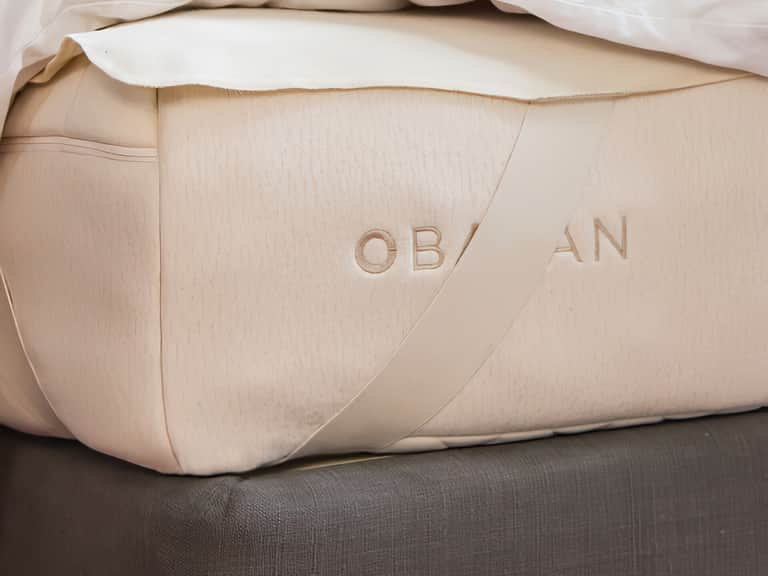
For a construction example, the Naturally Organic Hudson Latex Mattress is described as an eight-inch design with a three-inch medium Dunlop latex upper layer and a five-inch firm Dunlop latex core. Its published materials also describe a cotton wrapping and wool quilting. This example illustrates why a layer map is more useful than a broad “latex mattress” label: it gives readers specific details to examine. It is not a universal template, nor does the description establish that the feel will suit every sleeper.
The cover and surrounding materials count
Latex rarely works alone. The cover can affect how directly a sleeper perceives the latex beneath it. A tightly fitted cover may make the surface feel more taut; quilting can add a softer first contact and introduce another layer of materials between the sleeper and the core. The effect depends on the cover’s fabric, construction, thickness, and how it is attached.
Wool and cotton are common components in natural-material sleep surfaces, though their roles differ. Cotton may form the fabric cover or an inner wrap. Wool can add a quilted layer and is often included for its moisture-handling properties and its role in a mattress’s fire-safety design. These materials influence care as well as feel. A cover that is not removable, for example, should not be treated like a washable sheet or protector.
Ask what can be cleaned, what must be spot-treated, and whether the cover is intended to be removed. Follow the manufacturer’s care instructions: latex cores and quilted materials may not be suited to machine washing or drying. Protecting the mattress with compatible bedding can reduce routine soil, but it does not replace checking the product’s own maintenance guidance.
Temperature experience also depends on more than a single layer. Latex’s structure, cover materials, bedroom conditions, clothing, and bedding all contribute to the microclimate around the sleeper. Descriptions such as “cooling” or “breathable” should be treated as claims to investigate, not guarantees of a particular nighttime temperature.
Airflow and the support surface underneath
Air can move through some latex structures, but airflow through the material is only one part of the system. The cover and bedding can affect how freely heat and moisture escape, while the bed base may either allow or restrict air circulation beneath the mattress. A mattress placed on an unsuitable or poorly ventilated foundation may behave differently from one used on the support surface specified by its maker.
Check the manufacturer’s guidance for slat spacing, platform requirements, adjustable-base compatibility, and any ventilation recommendations. These details are easy to overlook when attention is fixed on firmness. They can matter to mattress stability, warranty conditions, and long-term care. Do not assume that every latex mattress can be used on every frame simply because latex is flexible or durable.
If evaluating a layered design, ask whether the layers are intended to be flipped, rotated, or rearranged. Some mattresses are built as a fixed unit; others may have different configurations. A claim of adjustability should be accompanied by practical instructions, including whether changing layer order affects the cover fit or warranty.
A practical construction checklist
Use the following questions when comparing descriptions. The goal is not to award points for complexity, but to establish what is actually inside the mattress and how the maker expects it to be used.
- How many layers are present, and what is the thickness of each?
- What material is used in every layer, including the cover and quilting?
- Is the latex described as natural, blended, or synthetic? Does the description identify which components the claim covers?
- Are firmness ratings given for individual layers, the finished mattress, or both?
- Are test figures such as ILD or IFD provided, and what method or layer do they refer to?
- How are layers held in place, and can they be moved or rearranged?
- Is the cover removable, washable, or spot-clean only?
- What type of foundation is required, and are slat spacing or ventilation instructions specified?
- What is the trial or return policy, warranty coverage, and process for reporting a problem?
- Are certification claims tied to named materials or to the finished product? Can the documentation be checked?
When a description omits key details, treat that as a reason to seek clarification—not proof of a flaw, and not a reason to fill in the gaps with assumptions. A useful answer should be specific enough to distinguish one construction from another.
Common assumptions worth checking
“Firmer means more supportive.” Firmness describes a sensation; support concerns how the mattress carries the body. They are related, but they are not interchangeable. A suitable surface should feel stable while still accommodating the sleeper’s shape and preferred position.
“More layers mean better construction.” Additional layers may allow a maker to tune feel, but layer count alone says nothing about how well the design works. A simple core can be deliberate; a complicated stack can be difficult to interpret. Look for clear specifications and a coherent purpose for each component.
“Natural latex always feels the same.” The phrase covers a wide range of constructions. Processing, formulation, firmness, thickness, and surrounding materials all affect the finished surface. Ask for details rather than relying on a single material name.
“Breathable materials guarantee cool sleep.” Material structure can contribute to air movement and moisture management, but room conditions and bedding also matter. No construction detail alone can guarantee that every sleeper will feel cool.
Read the mattress as a system
The most dependable way to understand natural latex construction is to read the mattress from the outside in: cover, quilted materials, comfort layer, any transition layer, support core, and the surface beneath it. Each part adds information. None, on its own, predicts the entire night’s experience.
Thickness tells you how much material is present; firmness describes resistance in a particular context; layer arrangement shows how those properties may interact. Material and certification details clarify what the components are, while care and base instructions explain how the mattress is intended to function over time. Taken together, these details make comparison more grounded and less dependent on marketing shorthand.
Comfort remains personal. A construction that appears sensible on paper still needs to be assessed in light of sleeping position, pressure preferences, shared-bed needs, and the support base available. Use specifications to narrow questions, not to substitute for experience. When the description is precise and the evaluation is patient, the word “latex” becomes a starting point for informed judgment—not the end of it.